The Atlas Mountains of Morocco reveal a completely different side of the country. Beyond the lively medinas, colorful souks, Atlantic beaches, and golden Sahara dunes lies a vast mountain world filled with cedar forests, deep valleys, traditional Amazigh villages, dramatic gorges, and snow-covered peaks.
For travelers exploring Morocco, the Atlas Mountains are much more than a beautiful backdrop. They form one of the country's most important geographical and cultural regions and create a natural transition between Morocco's northern plains and the landscapes approaching the Sahara.
The Moroccan Atlas is generally divided into three major ranges: the Middle Atlas, High Atlas, and Anti-Atlas. Each offers a different experience. The Middle Atlas is known for forests, lakes, mountain towns, and wildlife. The High Atlas contains Morocco's highest mountains and some of its most spectacular trekking routes. Farther south, the Anti-Atlas introduces travelers to rugged, arid landscapes approaching the Sahara.
If your journey begins in Fes, the mountains become particularly interesting. Traveling south from Fes toward Merzouga takes you through the Middle Atlas, making the mountains part of one of Morocco's classic journeys from an imperial city to the Sahara.
This guide explores what makes the Atlas Mountains special, where to go, when to visit, and how to include them in your Morocco itinerary.
Where Are the Atlas Mountains in Morocco?
The Atlas Mountains stretch across a large part of Morocco and continue across North Africa.
Within Morocco, the mountain system influences the country's landscapes, climate, agriculture, and travel routes. Depending on where you travel, the Atlas can appear as green forests, high snowy summits, fertile valleys, rocky plateaus, or dry mountains overlooking desert landscapes.
Morocco's Atlas region is normally divided into three principal ranges:
- Middle Atlas
- High Atlas
- Anti-Atlas
For visitors, understanding the difference between these regions makes planning much easier.
Travelers staying in Fes have convenient access to the Middle Atlas, including Ifrane and Azrou. Marrakech is a common starting point for exploring the High Atlas, while destinations such as Taroudant and Tafraoute provide access to the Anti-Atlas.
Together, these mountain regions demonstrate just how geographically diverse Morocco really is.
The Middle Atlas: Forests, Lakes and Mountain Towns
For travelers beginning their journey in Fes, the Middle Atlas Mountains are often their first encounter with Morocco's mountain landscapes.
The Middle Atlas stretches through areas including Ifrane, Azrou, Khénifra, Sefrou, Boulemane, and Midelt. Unlike the rocky scenery many visitors expect from Morocco, parts of the Middle Atlas are remarkably green.
Cedar and oak forests cover sections of the mountains, while lakes, agricultural land, volcanic plateaus, and small communities create a landscape that can feel far removed from the busy streets of Fes.
Ifrane: A Different Side of Morocco
One of the best-known destinations in the Middle Atlas is Ifrane.
With its clean streets, pitched roofs, gardens, and cool mountain climate, Ifrane looks very different from Morocco's historic medinas.
During winter, snow can transform the surrounding area. In warmer seasons, the cooler temperatures make Ifrane a refreshing stop between the cities and southern Morocco.
Its location also makes Ifrane a natural stop when traveling from Fes toward Azrou, Midelt, and eventually the Sahara.
Rather than rushing through, spend some time walking around and enjoying the change of atmosphere. The contrast between the architecture of Ifrane and the medieval lanes of Fes demonstrates how varied Morocco can be within a relatively short journey.
Azrou and the Cedar Forests
Continue south and the landscape becomes even more interesting around Azrou.
Azrou is surrounded by one of the Middle Atlas region's most characteristic environments: cedar forest.
The area is also famous for its Barbary macaques, a native primate species found in parts of Morocco and Algeria.
Seeing the macaques is often a memorable moment for travelers crossing the Middle Atlas, but visitors should observe wildlife responsibly. Avoid feeding wild animals and give them enough space to behave naturally.
Beyond wildlife, the forests provide opportunities to stop, walk, take photographs, and simply enjoy the mountain air before continuing south.
For travelers who have spent several days exploring Morocco's cities, these peaceful landscapes offer an enjoyable change of pace.
Midelt: Between the Mountains and the Desert
Continuing south from the Middle Atlas brings travelers toward Midelt.
The town occupies an important position on routes connecting northern Morocco with the southeastern regions.
For many travelers heading from Fes to Merzouga, Midelt is a convenient place to stop for lunch or take a break before continuing toward the Ziz Valley.
More importantly, the surroundings begin to show a dramatic transformation.
The greener scenery of the Middle Atlas gradually becomes drier and more rugged. Mountain slopes, rocky landscapes, and broad valleys start replacing the dense forests seen farther north.
This transition is one reason the journey from Fes to the Sahara Desert is so memorable.
The road is not simply transportation between two destinations. It is part of the experience.
From the Atlas Mountains to the Ziz Valley
After crossing the mountain landscapes south of Midelt, the scenery begins changing again as the road approaches the Ziz Valley.
This is one of the most visually impressive transitions on the route toward Merzouga.
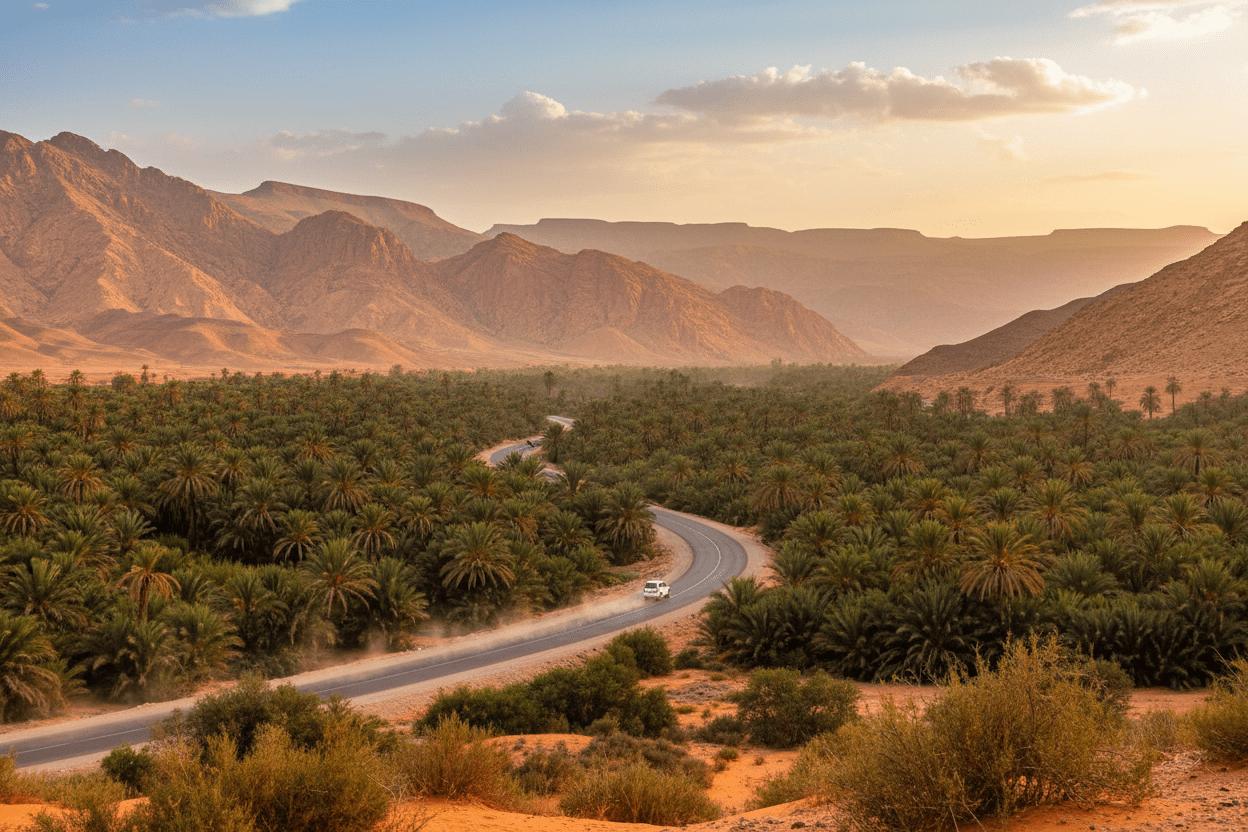
Rocky mountains and dry terrain suddenly open toward a long green corridor filled with palm trees and cultivated land.
The contrast is striking.
From elevated viewpoints, travelers can see the vegetation following the river through an otherwise arid landscape. Small settlements and traditional architecture appear among the palms.
The valley demonstrates the importance of water in southeastern Morocco and provides a beautiful introduction to the oasis landscapes found closer to the Sahara.
From here, travelers can continue toward Erfoud, Rissani, and eventually the dunes of Merzouga.
For this reason, the Atlas Mountains and Sahara Desert should not always be considered separate experiences. On a journey from Fes, they form different chapters of the same adventure.
The High Atlas: Morocco's Most Dramatic Mountains
While the Middle Atlas offers forests and accessible mountain scenery, the High Atlas Mountains provide Morocco's most dramatic elevations.
Stretching for hundreds of kilometers, the High Atlas includes deep valleys, remote villages, mountain passes, and many of the country's highest peaks.
At its heart stands Jbel Toubkal, which rises to approximately 4,167 meters and is the highest mountain in Morocco and North Africa.
The High Atlas is especially popular among hikers, trekkers, photographers, and travelers interested in rural Moroccan culture.
Jbel Toubkal and Imlil
Travelers planning to climb Jbel Toubkal commonly begin around Imlil, a mountain village south of Marrakech.
The region is very different from Morocco's major cities.
Walking trails connect valleys and villages, cultivated terraces climb the slopes, and enormous mountains dominate the horizon.
Climbing Toubkal requires proper planning and should not be treated as an ordinary sightseeing excursion. Conditions change with altitude and season, and appropriate equipment and local guidance are important.
However, you do not need to climb Morocco's highest mountain to enjoy the High Atlas.
Shorter walks, village visits, scenic drives, and valley excursions allow visitors to experience the region without undertaking a major trek.
Amazigh Culture in the Atlas Mountains
One of the most important reasons to explore the Morocco Atlas Mountains is cultural rather than geographical.
The mountains have long been home to Amazigh communities, whose traditions remain an essential part of Moroccan identity.
Throughout different parts of the Atlas, travelers encounter villages built into hillsides and valleys where agriculture and livestock remain important to everyday life.
Traditional houses often use materials suited to the local environment, including earth and stone. Terraced fields make use of limited mountain land, while local products vary according to altitude, climate, and region.
Traveling through these areas offers a different perspective on Morocco from what visitors experience in Fes, Marrakech, Casablanca, or other large cities.
However, mountain communities should not be treated simply as tourist attractions.
Visitors should approach villages respectfully, ask before photographing people, support local businesses when possible, and remember that these are living communities rather than open-air museums.
Responsible tourism can make interactions more meaningful for both travelers and residents.
The Anti-Atlas: Morocco's Rugged South
South of the High Atlas lies another remarkable mountain region: the Anti-Atlas.
Here, Morocco becomes noticeably drier.
The landscapes feature rugged mountains, unusual rock formations, arid valleys, oases, and traditional villages. The proximity of the Sahara strongly influences the scenery.
The Anti-Atlas generally receives fewer visitors than Morocco's famous imperial cities or the most accessible sections of the High Atlas, making it particularly appealing to travelers looking for quieter landscapes and road-trip experiences.
Tafraoute is one of the best-known bases for exploring this region.
Surrounded by dramatic rock formations and mountain scenery, it provides access to landscapes that feel distinctly different from the green cedar forests of the Middle Atlas.
The contrast demonstrates why speaking about "the Atlas Mountains" as if they were one uniform destination can be misleading.
Each section has its own character.
Best Things to Do in the Atlas Mountains
There is no single way to experience the Atlas.
Your ideal journey depends on the region you visit, the season, your fitness level, and the amount of time available.
Hiking and Trekking
Hiking is one of the most popular activities in the Atlas Mountains.
Options range from short village walks to multi-day expeditions.
The High Atlas provides the most famous trekking opportunities, including routes around Toubkal, but walking experiences can also be found throughout other mountain regions.
Travelers should always consider altitude, weather, trail conditions, and local advice before setting out.
Scenic Road Trips
You do not need to be a serious hiker to appreciate the mountains.
Some of Morocco's most memorable drives cross the Atlas.
The journey from Fes through Ifrane, Azrou, and Midelt toward the Sahara is an excellent example.
Instead of seeing the mountains from a single viewpoint, a road trip allows you to watch the environment transform hour by hour.
Discover Mountain Villages
Visiting smaller communities can add an important cultural dimension to a Morocco itinerary.
Travel slowly, respect local customs, and consider using local guides where appropriate.
Photography
The Atlas Mountains provide endless opportunities for landscape photography.
Snow-covered peaks, cedar forests, mud-brick villages, rocky valleys, palm oases, winding roads, and changing light create remarkably diverse scenes.
Early morning and late afternoon often provide especially beautiful light.
Best Time to Visit the Atlas Mountains
The best time to visit depends heavily on which part of the Atlas you intend to explore.
Spring
Spring is one of the most attractive periods for many mountain regions.
Temperatures are generally comfortable, valleys can be greener, and wildflowers may appear in some areas.
For travelers combining cities, mountains, and desert, spring can provide a good balance of conditions.
Summer
Summer can be extremely hot in parts of Morocco, particularly toward the Sahara and southern regions.
Higher elevations, however, may offer cooler conditions.
Travelers planning serious hikes should still prepare carefully for strong sunshine and temperature changes.
Autumn
Autumn is another excellent period for exploring Morocco.
Temperatures often become more comfortable after the peak of summer, making road trips and hiking attractive.
Winter
Winter transforms the higher Atlas elevations.
Snow is common in some mountain areas, and road or trekking conditions can change rapidly.
Winter landscapes can be spectacular, but travelers need suitable clothing and should check local conditions before entering high mountain areas.
What to Pack for an Atlas Mountains Trip
Packing depends on the season and activity, but mountain weather can differ significantly from conditions in Morocco's cities and desert.
Useful items include comfortable walking shoes, layered clothing, sun protection, water, a hat, and a light jacket.
For trekking at higher elevations, more specialized equipment may be required.
One of the most common mistakes travelers make is assuming that Morocco is hot everywhere throughout the year.
It is not.
Temperatures can drop significantly in mountain regions, particularly at night and during winter.
Atlas Mountains From Fes
If you're staying in Fes, you do not need to travel all the way to Marrakech to experience Morocco's mountains.
The Middle Atlas is naturally accessible from Fes.
A journey can include:
Fes → Ifrane → Azrou → Cedar Forest → Midelt
Travelers continuing toward the Sahara can then follow the route south through the Ziz region toward Erfoud and Merzouga.
This creates one of Morocco's most rewarding landscape transitions:
Imperial city → mountains → cedar forests → valleys → oases → Sahara Desert.
Instead of flying or traveling directly between major destinations, an overland journey allows you to see how Morocco changes geographically and culturally.
This is especially worthwhile for first-time visitors because it combines several different sides of the country within one itinerary.
Combining the Atlas Mountains and Sahara Desert
For travelers with limited time, combining the mountains with the desert is one of the best ways to experience Morocco's diversity.
A journey beginning in Fes can start with the historic medina before crossing the Middle Atlas and continuing toward Merzouga.
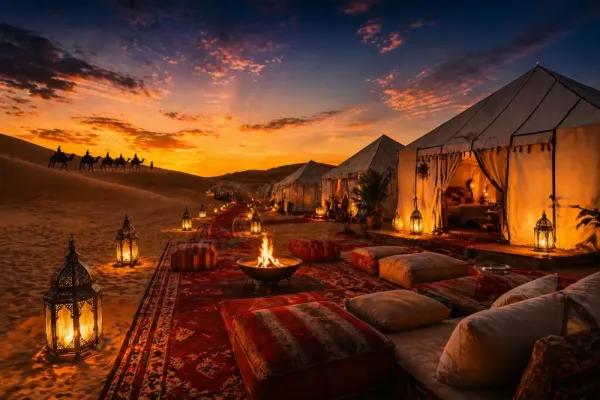
Once in the Sahara region, travelers can experience the Erg Chebbi dunes, desert sunsets, traditional communities, and the extraordinary silence of the desert.
The return journey can lead back to Fes, or a longer itinerary can continue through southern Morocco toward destinations such as Todra Gorge, the Dades Valley, Ouarzazate, Ait Ben Haddou, the High Atlas, and Marrakech.
This creates a complete journey across Morocco rather than a simple city-to-city transfer.
Responsible Travel in the Atlas Mountains
The beauty of the Atlas depends on fragile natural environments and local communities.
Travelers can help protect these regions through simple choices.
Avoid leaving waste on trails or at viewpoints. Carry reusable water containers where practical. Respect wildlife and never encourage animals to approach for photographs.
When visiting villages, respect local customs and privacy.
Buying food, crafts, or services directly from local businesses can also help tourism contribute more directly to mountain communities.
Most importantly, travel with patience.
Mountain journeys are not always about reaching the next attraction as quickly as possible. Some of the best moments come from stopping at a viewpoint, drinking tea in a small village, walking through a forest, or watching the landscape slowly change.
Are the Atlas Mountains Worth Visiting?
Absolutely.
The Atlas Mountains are one of the essential experiences in Morocco because they reveal a side of the country that many travelers do not expect.
The Middle Atlas offers forests, wildlife, mountain towns, and an unforgettable route from Fes toward the Sahara.
The High Atlas delivers towering peaks, valleys, trekking routes, and traditional villages.
The Anti-Atlas presents an entirely different world of dry mountains, rock formations, oases, and quiet southern landscapes.
Together, they tell an important part of Morocco's story.
Experience the Atlas Mountains on Your Morocco Journey
Morocco is often introduced through individual destinations: Fes, Marrakech, Chefchaouen, Casablanca, or the Sahara.
But some of the country's most memorable experiences happen between those places.
The Atlas Mountains are a perfect example.
Traveling south from Fes, the streets and historic walls of the imperial city gradually disappear. The road climbs toward Ifrane, forests appear around Azrou, mountains rise toward Midelt, and the environment becomes increasingly arid.
Eventually, the greenery of the Ziz Valley appears before the landscape opens toward the Sahara.
It is a journey through several different Moroccos in a single trip.
Whether you want to explore the Middle Atlas from Fes, cross the mountains on your way to Merzouga, hike through the High Atlas, discover Amazigh villages, or build a longer itinerary connecting Morocco's imperial cities with the desert, the Atlas Mountains deserve a place in your journey.
With Fes Morocco Tours, travelers can discover Morocco through carefully planned itineraries connecting its historic cities, mountain landscapes, valleys, traditional communities, and Sahara Desert.
Because in Morocco, the road between destinations can be just as unforgettable as the destination itself.